Academic Assessment
KBOCC engages in academic assessment at multiple, interconnected levels—institutional, program, general education, cocurricular, and course—to ensure that learning, teaching, and support systems reflect the College’s mission and Anishinaabe values. All of these assessment practices contribute to our continuous improvement and adherence to our mission.
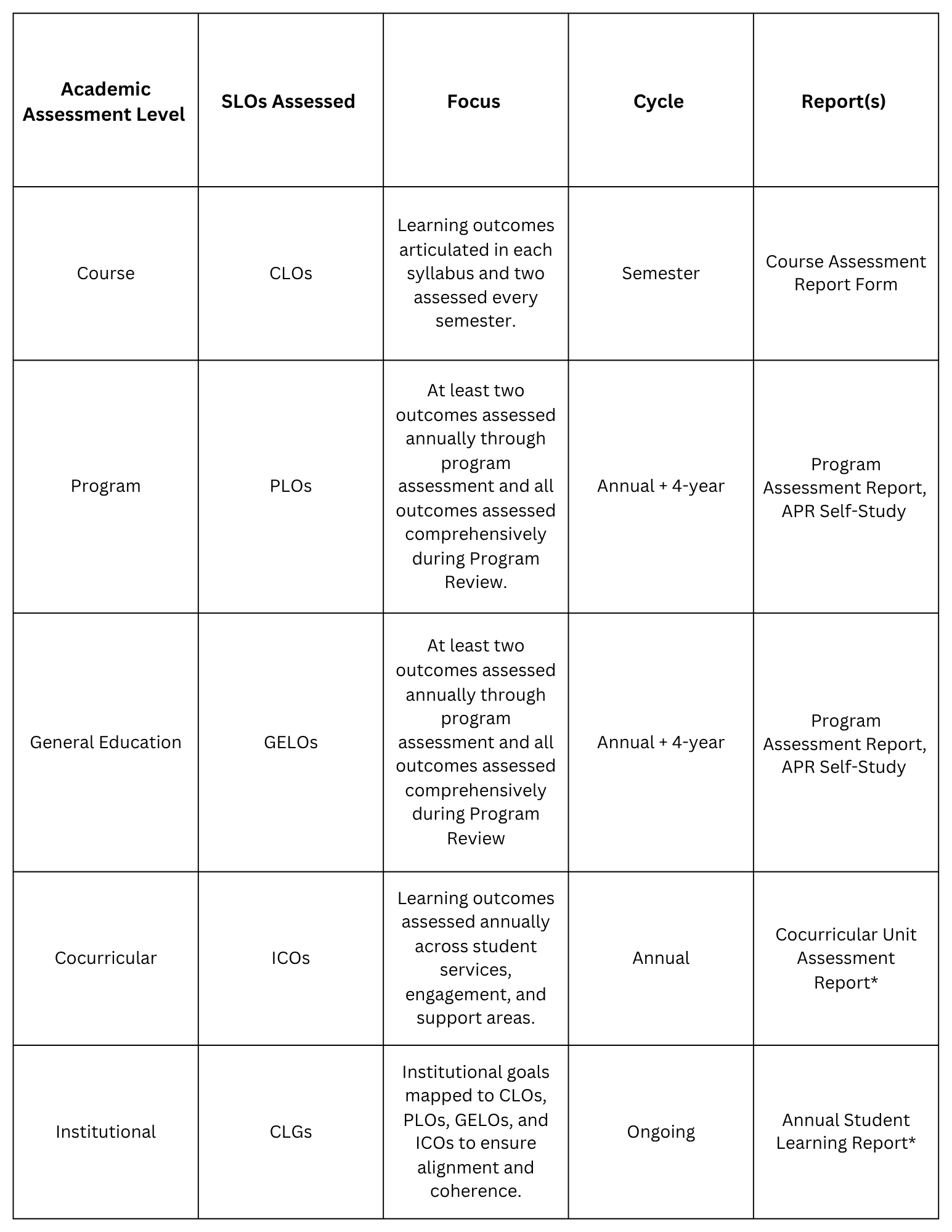
Student Learning Outcomes (SLOs) are articulated and mapped from the course and cocurricular activity levels, upward to the program, general education, and institutional levels. These outcomes are assessed in regular cycles, which range from semester, to annual, to multiyear.
Course Learning Outcomes (CLOs)
Our course learning outcomes are articulated in each syllabus and assessed each semester in every course.
Program Learning Outcomes (PLOs)
Our program learning outcomes are assessed on an annual rotation through program assessment and comprehensively on a four-year cycle during Program Review.
Institutional Cocurricular Learning Outcomes (ICOs)
A new Cocurricular Assessment Framework now guides the assessment of our institutional cocurricular learning outcomes, which are assessed annually across academics, student services, engagement, and support areas beginning in AY2025-26.
General Education Learning Outcomes (GELOs)
Our general education learning outcomes are assessed annually on a rotation through program assessment and comprehensively on a four-year cycle during Program Review. KBOCC launched a focused project in AY2025-26 to refine and strengthen General Education Assessment processes.
College Learning Goals (CLGs)
Our college learning goals are mapped to ICOs, GELOs, and PLOs for consistency and to ensure alignment and coherence.
Student Learning Outcome (SLO) Life Cycle
* New in AY2025–26
Program Assessment, Review, and Library
Academic programs and general education participate in both annual program assessment and comprehensive program review. The program review process is coordinated by the Office of Institutional Effectiveness and overseen by the Assessment Committee.
Visit Program Review for more information.
Annual Program Assessment
Each program and general education assesses at least two learning outcomes, analyzes data, and identifies short-term improvements, ensuring that all learning outcomes are assessed at least once over a four-year period.
Comprehensive Assessment with Program Review
Synthesizes multiple years of assessment to evaluate overall program quality, relevance, and impact. Program review connects evidence of student learning with long-term planning, community needs, and institutional goals.
Program Assessment Report Library
Our website maintains a record of the most recent academic assessment reports. Additional reports may be required from the Assessment and Curriculum Coordinator.
AY2024–25 Program Assessment Reports
Student Success
Success at a tribal college extends beyond academics. KBOCC’s assessment practices embrace a holistic understanding of achievement, guided by Anishinaabe values and student voice.
The Student Success Council (SSC) plays a central role in coordinating this work. In collaboration with OIE and the Assessment Committee, SSC reviews student success outcomes data, identifies barriers and opportunities, and monitors progress toward institutional goals for student success. The SSC uses findings to guide planning, recommend improvements and strategies, and supports the College’s Strategic Enrollment Management (SEM) and institutional effectiveness efforts.
Examples of ongoing assessment work include the following:
Integration of Anishinaabe knowledge and culture in coursework and cocurricular activities
Assessment of student belonging, wellness, and support through surveys and focus groups
Monitoring of student momentum such as credit completion, credit accumulation, and gateway course completion rates to identify barriers to outcomes
Monitoring of student outcomes such as retention, persistence, graduation, and transfer rates to identify barriers and support
Evaluation of student engagement through Community College Survey of Student Engagement (CCSSE) and other institutional instruments
Cocurricular Learning: Out-of-classroom learning experiences, or “cocurriculars,” are assessed across the institution beginning AY2025–26.
Operational
Operational assessment focuses on the non-academic functions that sustain KBOCC’s mission—such as finance, facilities, technology, and administrative services. Units assess their effectiveness through quarterly progress reports and strategic plan alignment reviews coordinated by the OIE.
A formal Institutional Effectiveness Framework is being developed to ensure that operational assessment is directly tied to the College’s Strategic Plan. This approach integrates academic and operational planning, allowing the institution to make data-informed decisions that support both student learning and long-term sustainability.